Why Your Next Vehicle Might Not Come with a Battery: 5 Takeaways from India's EV Revolution
Battery as a Service (BaaS) and battery swapping are changing the economics of electric mobility by separating the battery from the vehicle and reducing charging downtime.
Battery Swapping at a Glance
The Basic Idea
Conventional EV ownership generally combines the vehicle and battery into one purchase. Under BaaS, the consumer can purchase or lease the vehicle while obtaining battery access as a separate service.
1. The "Battery-Free" Purchase: Decoupling Ownership
Battery as a Service
The BaaS model separates the battery from the vehicle purchase. The consumer can obtain access to battery capacity through a service arrangement rather than bearing the entire battery cost upfront.
This can reduce the initial acquisition cost and convert part of EV ownership into a recurring service expenditure.
2. The Grid Question: Charging vs Swapping
Conventional Fast Charging
- Requires the vehicle to remain connected while charging.
- High-power charging can create significant instantaneous electricity demand.
- Large-scale deployment requires suitable grid infrastructure.
- Peak-hour charging can increase demand-management challenges.
Battery Swapping
- The depleted battery is replaced with a charged battery.
- The vehicle can resume operation rapidly.
- Stations can manage when batteries are recharged.
- Charging can potentially be coordinated with grid conditions and tariffs.
How Battery Swapping Works
3. Space is the New Urban Constraint
Conventional Charging
Conventional charging infrastructure generally requires the vehicle to occupy a parking space during the charging period.
In dense urban areas, this creates a direct relationship between charging time, parking demand and land requirement.
Swapping Stations
A swapping station stores batteries separately from the vehicles and can therefore serve multiple vehicles without requiring each vehicle to remain parked for the full charging cycle.
This can make battery swapping particularly relevant for high-utilisation 2W and 3W fleets.
Battery Swapping Infrastructure
Why 2W and 3W?
- Smaller batteries are easier to handle.
- Commercial vehicles have high daily utilisation.
- Downtime directly affects earning potential.
- Swapping can reduce vehicle waiting time.
- Stations can be deployed in compact urban locations.
4. The "Skeleton" Vehicle: Separating Vehicle and Battery
Regulatory Architecture
A major challenge for battery swapping is ensuring that vehicle approval, battery specifications and ownership arrangements work together without restricting technological innovation.
Government policy has therefore emphasised interoperability standards covering battery form factor, communication protocols, connectors and related systems.
5. Interoperability: The Real "Holy Grail"
Closed Ecosystem
A closed ecosystem can create vendor lock-in and limit consumer flexibility.
Interoperable Ecosystem
Interoperability can improve consumer choice, network utilisation and scalability.
Battery Management System: The Digital Safety Layer
BMS
The Battery Management System monitors and manages battery operating conditions.
Safety
Monitoring battery parameters is essential for controlling risks associated with abnormal temperature, voltage and current conditions.
Battery Health
Battery data can support assessment of battery condition, usage history and suitability for continued operation.
Explore the Battery-Swapping Ecosystem
Why is battery swapping particularly relevant to delivery fleets?
Does battery swapping eliminate charging infrastructure?
Why is interoperability important?
Can retired EV batteries have a second life?
India's Policy and Infrastructure Push
Union Budget 2022–23 proposed a Battery Swapping Policy and interoperability standards and encouraged Battery or Energy as a Service business models. :contentReference[oaicite:4]{index=4}
PIB stated that battery swapping could address upfront cost, downtime and space constraints while promoting interoperability. :contentReference[oaicite:5]{index=5}
PIB reported that battery swapping was already operational in India and was being used particularly for two- and three-wheelers. :contentReference[oaicite:6]{index=6}
The Ministry of Power issued the Guidelines for Installation and Operation of Battery Swapping and Charging Stations. :contentReference[oaicite:7]{index=7}
PIB reported government support for automated, IoT-enabled battery-swapping infrastructure, including a project capable of completing a battery swap in under 40 seconds. :contentReference[oaicite:8]{index=8}
EV Charging Infrastructure: Current Context
Battery Swapping and the Electricity Grid
A key advantage of separating battery charging from vehicle operation is that the station can potentially manage charging schedules independently of when the vehicle requires mobility.
Charging vs Battery Swapping
| Parameter | Conventional Charging | Battery Swapping |
|---|---|---|
| Energy replenishment | Battery charged inside vehicle | Charged battery exchanged for depleted one |
| Vehicle downtime | Linked to charging duration | Potentially much shorter |
| Space requirement | Vehicle parking during charging | Battery storage plus limited vehicle space |
| Grid management | Vehicle charging directly determines demand | Station can manage battery charging separately |
| Interoperability | Connector and charging standards are important | Battery form factor and communication standards become critical |
| Best suited applications | Private vehicles and locations with longer parking time | High-utilisation 2W/3W and fleet applications |
Potential Advantages of Battery Swapping
Lower Upfront Cost
Separating the battery from the vehicle can reduce the initial purchase burden under a suitable BaaS business model.
Lower Downtime
Battery exchange can be considerably faster than waiting for a depleted battery to recharge.
Lower Space Requirement
Vehicles need not remain parked at a charging point throughout the complete charging cycle.
Fleet Utilisation
High-use commercial fleets can potentially increase operating time by reducing energy-replenishment downtime.
Battery Lifecycle Management
Centralised battery management can make monitoring, maintenance and lifecycle assessment easier.
Service-Based Ownership
BaaS can shift part of EV expenditure from an upfront capital cost to an ongoing service model.
Challenges to Scaling Battery Swapping
1. Standardisation
Different battery dimensions, connectors and communication systems can prevent interoperability.
2. Battery Ownership
BaaS requires clear rules for battery ownership, leasing, liability and maintenance.
3. Safety
Battery storage and repeated swapping require robust safety monitoring and battery-management systems.
4. Network Density
Swapping becomes more useful when consumers can access stations conveniently across their normal travel routes.
5. Battery Compatibility
Interoperability requires compatibility at the mechanical, electrical and communication levels.
6. Business Model
Operators must balance battery utilisation, replacement costs, electricity prices, station investment and consumer subscription charges.
Government Support
Battery Swapping Policy
BIS Standards
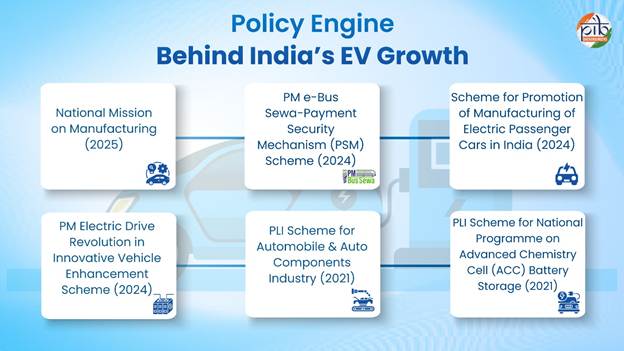
Battery Swapping and Charging Guidelines, 2025
PM E-DRIVE
The Future: From Battery Ownership to Energy Access
Way Forward
- Develop common battery and communication standards.
- Ensure interoperability without suppressing technological innovation.
- Strengthen battery safety and BMS requirements.
- Develop dense swapping networks for high-use mobility corridors.
- Integrate swapping stations with smart-grid management.
- Develop transparent BaaS pricing and consumer-protection rules.
- Enable battery health and lifecycle monitoring.
- Promote second-life applications and responsible recycling.
UPSC Mains Perspective
Introduction
Battery swapping represents a shift from conventional EV charging towards a service-oriented energy-replenishment model, particularly relevant for high-utilisation two- and three-wheelers.
Key Dimensions
Conclusion
Battery swapping can complement conventional charging by addressing the specific requirements of high-utilisation EV segments. Its success will depend on interoperability, safety, business viability, infrastructure density and consumer confidence.
The Future May Not Be About Owning the Battery
The fundamental innovation behind BaaS is not simply a faster way to charge an electric vehicle. It is a change in the ownership and service model of mobility.
Instead of asking only how quickly an EV can charge, the ecosystem increasingly asks whether the vehicle needs to wait for energy at all.
India's EV transition could therefore evolve from vehicle ownership + battery ownership towards vehicle ownership + energy access.