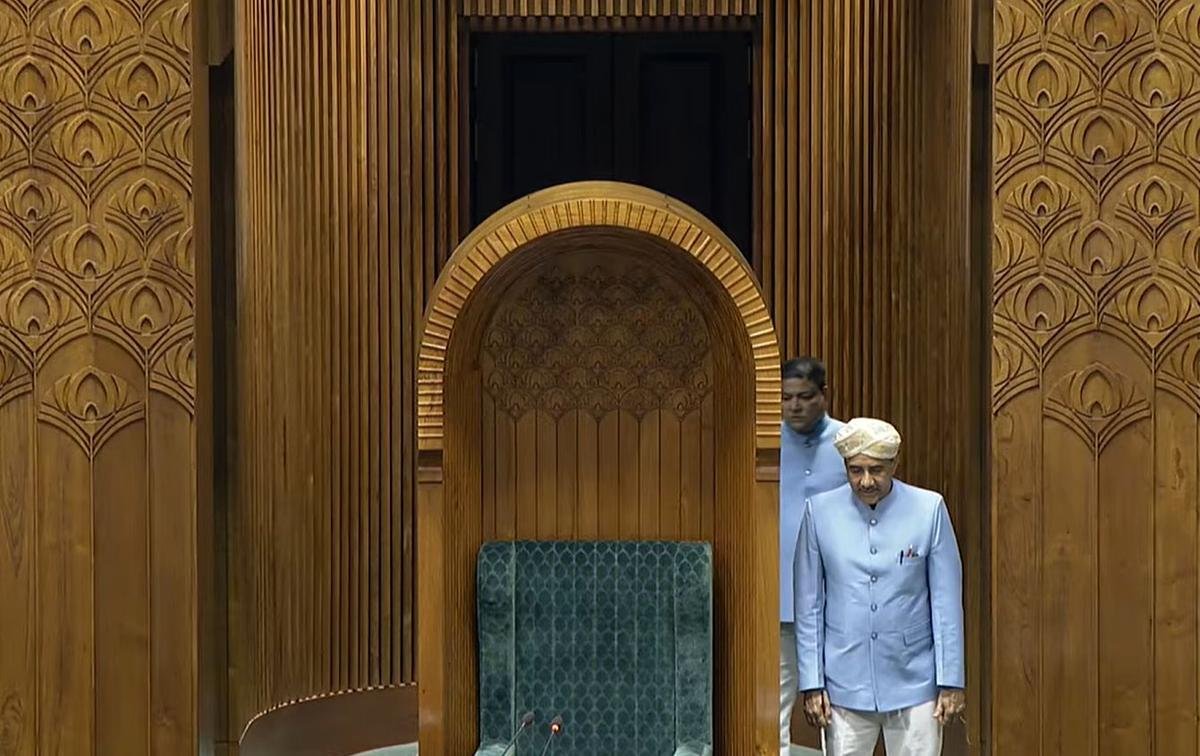
Office of the Speaker of Lok Sabha
Comprehensive notes on the constitutional position, powers, landmark Supreme Court judgments, anti-defection law, Money Bill certification, parliamentary conventions and institutional reforms.
Constitutional Position
Core principle
The Speaker is the presiding officer and institutional guardian of the Lok Sabha. The office mediates between majority rule, opposition rights and constitutional procedure. Its credibility depends on impartiality, procedural fairness and accountability.
| Article | Constitutional provision | Mains relevance |
|---|---|---|
| 93 | Election of Speaker and Deputy Speaker. | Constitutional foundation of the offices. |
| 94 | Vacation, resignation and removal. | Tenure and accountability. |
| 95 | Performance of duties in specified circumstances. | Continuity of proceedings. |
| 96 | Presiding restriction during consideration of a removal resolution. | Conflict-of-interest safeguard. |
| 97 | Salaries and allowances of presiding officers. | Institutional independence. |
| 100 | Voting, quorum and vacancies. | Decision-making procedure. |
| 108 | Joint sitting of both Houses. | Legislative deadlock resolution. |
| 110 | Definition and certification of Money Bills. | Bicameralism and judicial review. |
| 118 | Rules regulating parliamentary procedure. | Procedural autonomy. |
| 122 | Courts and parliamentary proceedings. | Limits of judicial intervention. |
| 102(2) | Disqualification under the Tenth Schedule. | Anti-defection adjudication. |
Election and tenure
- The Lok Sabha elects the Speaker from among its members under Article 93.
- Under Article 94, the Speaker continues until immediately before the first meeting of the newly elected Lok Sabha, unless the office is vacated earlier.
- The Speaker may resign by writing to the Deputy Speaker.
- The Speaker does not automatically vacate office on dissolution of the Lok Sabha.
Powers and Functions
Presiding functions
- Maintains order and decorum.
- Regulates debates and recognises members to speak.
- Interprets and applies House rules.
- Decides procedural questions within the applicable rules.
Legislative functions
- Regulates the conduct of business under House rules.
- Presides over joint sittings under Article 108.
- Exercises a casting vote in case of a tie under Article 100.
- Facilitates orderly legislative deliberation.
Financial functions
- Certifies Money Bills under Article 110.
- Certification affects the legislative role of the Rajya Sabha.
- Must be exercised within the constitutional definition.
Committee and administrative functions
- Exercises committee-related powers where authorised.
- Performs administrative functions under parliamentary rules.
- Balances members' procedural rights with orderly conduct.
Impartiality and Institutional Challenges
| Challenge | Concern | Implication |
|---|---|---|
| Party affiliation | The Speaker is usually elected from the majority. | Perceptions of partisan decisions. |
| Anti-defection cases | Delays or inconsistent timelines. | Uncertainty over representation and government stability. |
| Money Bill certification | Disputes over Article 110. | Concerns about bicameral scrutiny. |
| Suspension of MPs | Extensive suspension may restrict opposition participation. | Reduced deliberation and accountability. |
| Committee scrutiny | Important Bills may receive limited examination. | Weaker legislative quality. |
| Deputy Speaker vacancy | Failure to elect a Deputy Speaker. | Concerns about institutional balance. |
Constitutional morality
Parliamentary authority rests on formal powers as well as public confidence in fair procedure. Reasoned decisions, neutral rulings and consistent application of rules strengthen institutional legitimacy.
Landmark Supreme Court Judgments
Kihoto Hollohan v. Zachillhu (1992)
The Court upheld the Tenth Schedule's constitutional validity, while recognising judicial review of decisions made by the Speaker or Chairman under the Schedule.
Mains relevance: The Speaker's adjudicatory power is not beyond judicial scrutiny.
Nabam Rebia v. Deputy Speaker (2016)
The Court addressed the interaction between a pending notice for removal of the Speaker and disqualification proceedings. The judgment raised important questions about the design of the anti-defection adjudication mechanism.
Mains relevance: Balance procedural safeguards with timely adjudication.
Keisham Meghachandra Singh v. Speaker (2020)
The Court emphasised that disqualification petitions should ordinarily be decided within a reasonable period, generally three months unless exceptional circumstances justify delay. It also suggested considering an independent adjudicatory mechanism.
Mains relevance: Timely decisions and institutional independence.
Subhash Desai v. Principal Secretary, Governor of Maharashtra (2023)
The Constitution Bench examined issues concerning legislative party leadership, the Governor's role and the Speaker's adjudicatory responsibilities. It clarified the importance of distinguishing a political party from its legislature party.
Mains relevance: Party identity, legislative authority and constitutional accountability.
Raja Ram Pal v. Speaker, Lok Sabha (2007)
The Court recognised judicial review of parliamentary action where substantive illegality or unconstitutionality is alleged, while respecting constitutional protections for internal procedure.
Mains relevance: Parliamentary privilege is not unlimited immunity from judicial review.
Rojer Mathew v. South Indian Bank Ltd. (2019)
The Court raised significant issues about Money Bill certification and the scope of Article 110, illustrating the continuing debate over bicameralism and judicial review.
Mains relevance: Financial legislation and the role of the Rajya Sabha.
The British Convention
United Kingdom
- The Speaker withdraws from active party politics in practice.
- Major parties conventionally do not contest against a sitting Speaker seeking re-election.
- Impartiality is a central convention of the House of Commons.
India
- The Speaker is elected from among Lok Sabha members.
- There is no constitutional requirement to resign from the party.
- Institutional neutrality depends on practice, rules and conventions.
Anti-Defection Law and the Speaker
The Tenth Schedule, inserted by the 52nd Constitutional Amendment Act, 1985, provides for disqualification on specified grounds relating to defection. Under paragraph 6, the Speaker or Chairman ordinarily decides disqualification questions under the Schedule.
Grounds for disqualification
- Voluntarily giving up membership of the political party.
- Voting or abstaining contrary to a party direction without prior permission, unless condoned within 15 days.
- Specific rules apply to independent and nominated members.
Merger exception
- Paragraph 4 recognises a merger exception where at least two-thirds of the legislature party agree to the merger.
- It is not a general exemption for any two-thirds group of legislators.
- The earlier split exception was removed by the 91st Amendment Act, 2003.
Key concerns
- Partisan adjudication: The Speaker may belong to the governing party whose majority is affected.
- Delay: Pending petitions can influence confidence votes and legislative strength.
- Restricted dissent: Broad use of party whips may limit members' independent judgment.
Money Bill Certification
Article 110
A Bill qualifies as a Money Bill only if it contains provisions dealing with one or more of the matters specified in Article 110(1), including taxation, government borrowing, the Consolidated Fund of India and appropriation from that Fund, subject to the Article's precise terms.
Why certification is controversial
- The Rajya Sabha can make recommendations but cannot amend or reject a Money Bill.
- The Rajya Sabha must return a Money Bill within 14 days.
- Certification can substantially affect the Upper House's role in legislative scrutiny.
- Disputes arise when a Bill includes provisions whose connection to Article 110 is contested.
Way forward
- Apply Article 110 narrowly and in accordance with its text.
- Publish clear reasons for certification decisions where appropriate.
- Strengthen transparency and legislative scrutiny of financial legislation.
Suspension of Members of Parliament
The Speaker has procedural powers to maintain order and ensure orderly conduct. The applicable Lok Sabha Rules determine the procedure for dealing with disorderly conduct.
Rationale
- Maintain decorum.
- Protect orderly proceedings.
- Prevent persistent obstruction of House business.
Concerns
- Extensive suspensions may reduce opposition scrutiny.
- Important Bills may receive less debate.
- Disproportionate action can weaken public confidence.
Removal Procedure
Step 1 — Notice
A removal resolution requires at least 14 days' notice.
Step 2 — Consideration
The Lok Sabha considers the resolution under the Constitution and its rules.
Step 3 — Effective majority
Article 94(c) requires a majority of all the then members of the House.
Step 4 — Presiding restriction
Under Article 96, the Speaker cannot preside while the removal resolution is under consideration. The Speaker may participate and vote in the first instance, but has no casting vote.
Pro Tem Speaker
A Pro Tem Speaker is a temporary presiding officer who facilitates essential proceedings at the beginning of a newly constituted Lok Sabha, particularly the administration of oaths or affirmations and the election of the regular Speaker.
Principal functions
- Presides over initial proceedings.
- Facilitates members' oaths or affirmations as authorised.
- Conducts proceedings related to election of the regular Speaker.
Constitutional context
- Articles 93, 95, 99 and 100 provide relevant context.
- The Pro Tem Speaker is a temporary arrangement.
- Convention and executive practice shape the appointment process.
NCRWC and Parliamentary Reforms
The National Commission to Review the Working of the Constitution (NCRWC), chaired by Justice M. N. Venkatachaliah, examined parliamentary functioning and constitutional institutions.
| Reform area | Proposal / issue | Expected benefit |
|---|---|---|
| Parliamentary sittings | A more predictable and adequate annual sitting calendar. | Greater scrutiny. |
| Committee scrutiny | Refer more Bills for detailed examination. | Better legislative quality. |
| Anti-defection | Review adjudication and institutional independence. | Timely, credible decisions. |
| Deputy Speaker | Strengthen compliance with Article 93. | Institutional balance. |
| Legislative debate | Protect meaningful participation and deliberation. | Greater accountability. |
Reform of the Party Whip
The party whip maintains party discipline. However, extensive use of binding directions on ordinary legislative matters may restrict independent deliberation and the representative role of MPs.
Potential benefits
- Greater freedom for MPs to express constituency concerns.
- More meaningful debate on ordinary legislation.
- Better balance between discipline and independent judgment.
Possible approach
- Consider limiting strict whips to confidence motions and core financial business.
- Preserve accountability on matters essential to government stability.
- Review the relationship between whip reform and the Tenth Schedule.
Ordinances and Legislative Accountability
Ordinance-making is a distinct constitutional issue but remains relevant to broader debates on legislative scrutiny and accountability.
Constitutional provisions
- Article 123: President's ordinance-making power, subject to constitutional conditions.
- Article 213: Governor's ordinance-making power, subject to constitutional conditions.
- Ordinances remain subject to constitutional and legislative limits.
Important judgments
- D. C. Wadhwa (1987): Re-promulgation of ordinances was criticised as a constitutional abuse.
- Krishna Kumar Singh (2017): The Court examined constitutional limits on ordinance-making and re-promulgation.
Way Forward
1. Strengthen impartiality
Encourage cross-party consultation and non-partisan application of House rules.
2. Ensure timely adjudication
Set credible timelines for anti-defection decisions, with safeguards against strategic delay.
3. Improve legislative scrutiny
Refer important Bills to committees where appropriate and provide adequate debate time.
4. Protect opposition participation
Apply disciplinary powers proportionately and preserve meaningful scrutiny.
5. Clarify Money Bill practice
Apply Article 110 strictly and strengthen transparency around certification.
6. Strengthen conventions
Promote political restraint, institutional respect and predictable parliamentary calendars.
UPSC Mains Answer Framework
Question
“The impartiality of the Speaker is vital for the effective functioning of parliamentary democracy in India.” Discuss the challenges and suggest reforms.
Introduction
The Speaker, elected under Article 93, occupies a central position in the Lok Sabha. The office must balance majority rule with opposition rights, procedural fairness and constitutional accountability.
Key challenges
- Political affiliation may create perceptions of bias.
- Delays in anti-defection adjudication can affect legislative outcomes.
- Money Bill certification raises questions about bicameralism.
- Suspensions and limited debate may weaken legislative scrutiny.
Reforms
- Strengthen non-partisan conventions and procedural transparency.
- Introduce credible timelines for disqualification decisions.
- Consider independent adjudication through appropriate constitutional reform.
- Increase committee scrutiny and protect meaningful debate.
- Apply disciplinary powers proportionately.
Conclusion
The Speaker's authority rests on constitutional powers and the trust of the House. Stronger impartiality, transparency and accountability can help Parliament function as an effective forum of representation, deliberation and executive oversight.
Keywords for value addition
Quick Revision
Constitutional articles
Article 93: Speaker and Deputy Speaker. Article 94: Vacation, resignation and removal. Article 95: Performance of duties in specified circumstances. Article 96: Removal proceedings. Article 100: Voting and quorum. Article 108: Joint sitting. Article 110: Money Bills. Article 118: Rules of procedure. Article 122: Parliamentary proceedings.
Cases to remember
- Kihoto Hollohan (1992): Judicial review of anti-defection decisions.
- Nabam Rebia (2016): Removal notices and disqualification proceedings.
- Keisham Meghachandra Singh (2020): Timely disqualification decisions.
- Subhash Desai (2023): Political party, legislature party and the Tenth Schedule.
- Raja Ram Pal (2007): Judicial review of parliamentary action.
- Rojer Mathew (2019): Money Bill certification issues.
- D. C. Wadhwa (1987): Re-promulgation of ordinances.
- Krishna Kumar Singh (2017): Constitutional limits on ordinance-making.
High-value reform points
- Build cross-party consensus around the Speaker's impartiality.
- Ensure timely and reasoned decisions in anti-defection cases.
- Consider independent adjudication through constitutional reform.
- Use Money Bill certification strictly within Article 110.
- Strengthen committee scrutiny and parliamentary debate.
- Balance discipline with opposition participation.
Final takeaway
An impartial Speaker is indispensable for legislative fairness, opposition participation and the credibility of parliamentary democracy. Institutional conventions, transparent procedures and appropriate constitutional reforms can reinforce this role.